top of page
Sadasarvada Purvapar
"As a part of the process, the director and I conducted a workshop with theatre artists and (humanities and media studies) students to explore the connections between the archive and performance-making. Sharmistha developed a performance exhibition that involved the curation of interludes of visual and performance exhibits within the narrative of the performance traditions as well as the relevant socio-political context in colonial India. It was an exercise of animating the archival material with theatrical energies to bring about the synergies between the archive, society and individuals. Instead of presenting a linear narrative by establishing a connection between the archive and the performance, Sharmistha’s idea of performance exhibition helped me explore the power dynamics between actors managers and patrons through the stories of the material objects and exhibiting them in a space. As a writer sitting through the process, I could respond to visual images, abstract movements and soundscapes that enabled me to sketch different scenes for the process and later writing of the play, Sadasarvada Purvapar." - Ashutosh Potdar
About the play
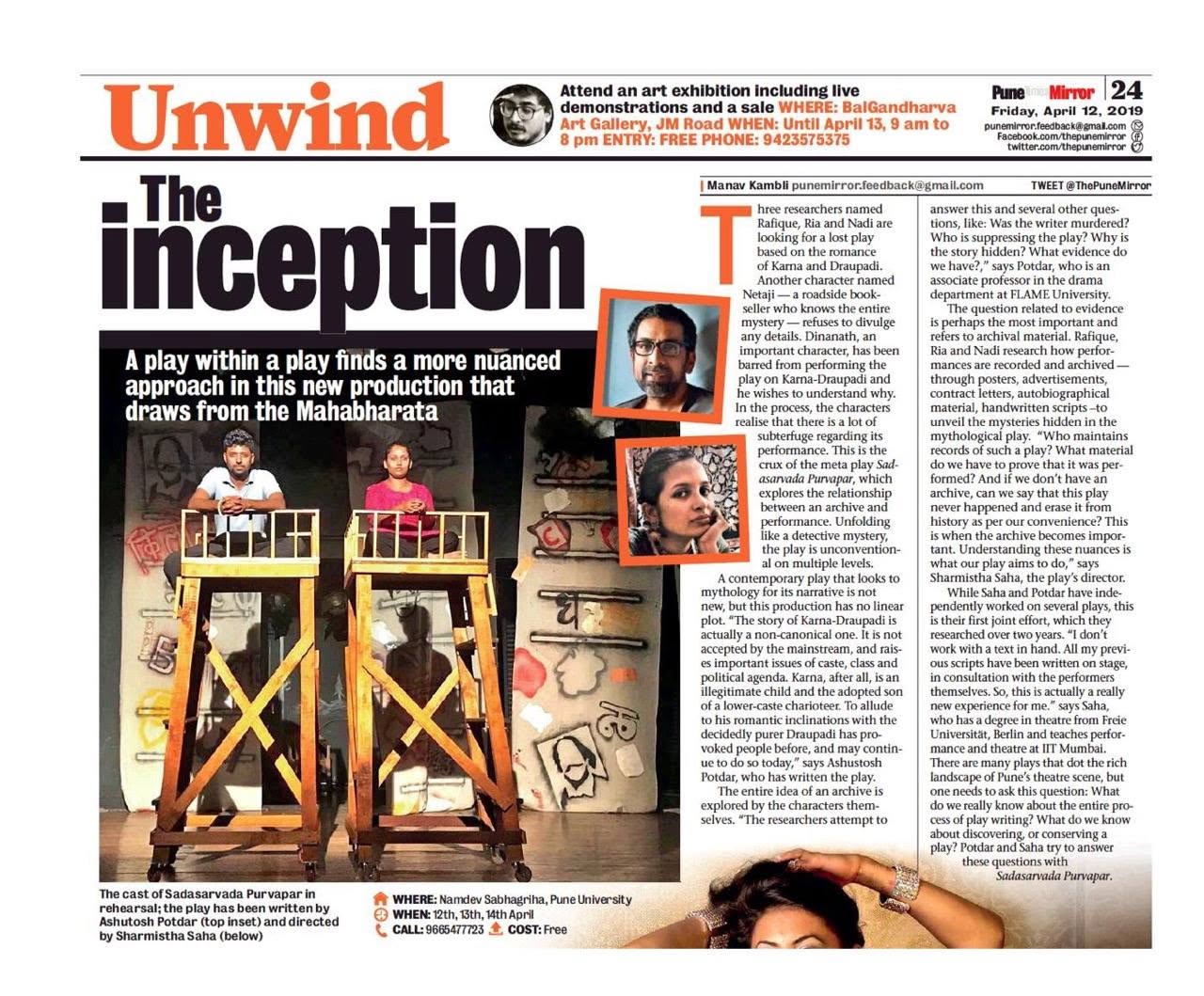
Sadasarvada Purvapar is the story of a man called Netaji who owns a second hand bookshop. He also likes collecting old newspapers, magazines and all kinds of documents and objects related to theatre. He lives in his world with characters from theatre history who come to talk to him when he is alone. One day Riya who is researching for her new play based on the archival material of Marathi theatre comes to meet him. Riya and her friends Nadi and Rafique who are her collaborators in making the play discover a script ‘Karna-Draupadi’ in the process of their research. Riya tries to recreate ‘Karna-Draupadi’ and the story about the making of the play. A series of events unfold about the author of the script, it’s original actors and a riot. Riya, Nadi and Rafique struggle to join the dots in their quest for the truth about the play. Do they succeed? Is Netaji hiding something from them? Sadasarvada Purvapar explores human relationship to material, objects, history as it tries to find out more about power structures, identities, ideologies, creativity and love.
Director’s note
What is our relationship to the work we do? Are they only projects we take up for money or is there something more than that? What about the human relationships that we build with the people we work? Or with the objects, data, material that we collect, analyse or mould? Do they say anything about us and about our world? The play Sadasarvada Purvapar began as an exploration of archival material about theatre in colonial Maharashtra and Bengal two years back with the playwright Ashutosh Potdar. Borrowing from our understanding of our research work on archival material, Ashutosh created characters of the play who explored ideas rather than being tools to take a story forward. Once the play was written, I opened up the archival material of Marathi and Bengali theatre history once again to the actors, who then devised sequences that were initially not there in the play written by Ashutosh. The written dramatic text, the devised pieces by actors helped me to imagine human relationship to past, history, object and our actions in the present as a live performance for stage. With help from the playwright and the actors I tried to create a play about archive, history and past instead of a historical play.
Director Sharmistha Saha
Playwright Ashutosh Potdar
Music Aman Nath, Prabhakar, Pradeep
Songs written by Prabhakar
Ensemble scenes based on archival material created by actors
Lights
Costume
Set and Properties
Cast
Netaji
Nadi
Rafique
Riya
Ensemble Cast
Vishnudas Bhave/Tailor
Govind Mahadaji/ Actor of Riya
Govind’s wife
Raoji Vitthal Bhatekar/ Actor of Riya
Vishnushastri Chiplunkar
Parsi Actor (Shakuntala)/ Actor of Bhave
Parsi Actor (Dushyant)/ Actor of Bhave
Binodini Dasi/ Actor of Riya
Girish Ghosh/Actor of Riya
Satyendranath Tagore
Shakespeare/Actor of Bhave
Commissioned by Lalit Kala Kendra, Pune University,
Critical writing

01
Sadasarvada Purvapar

01
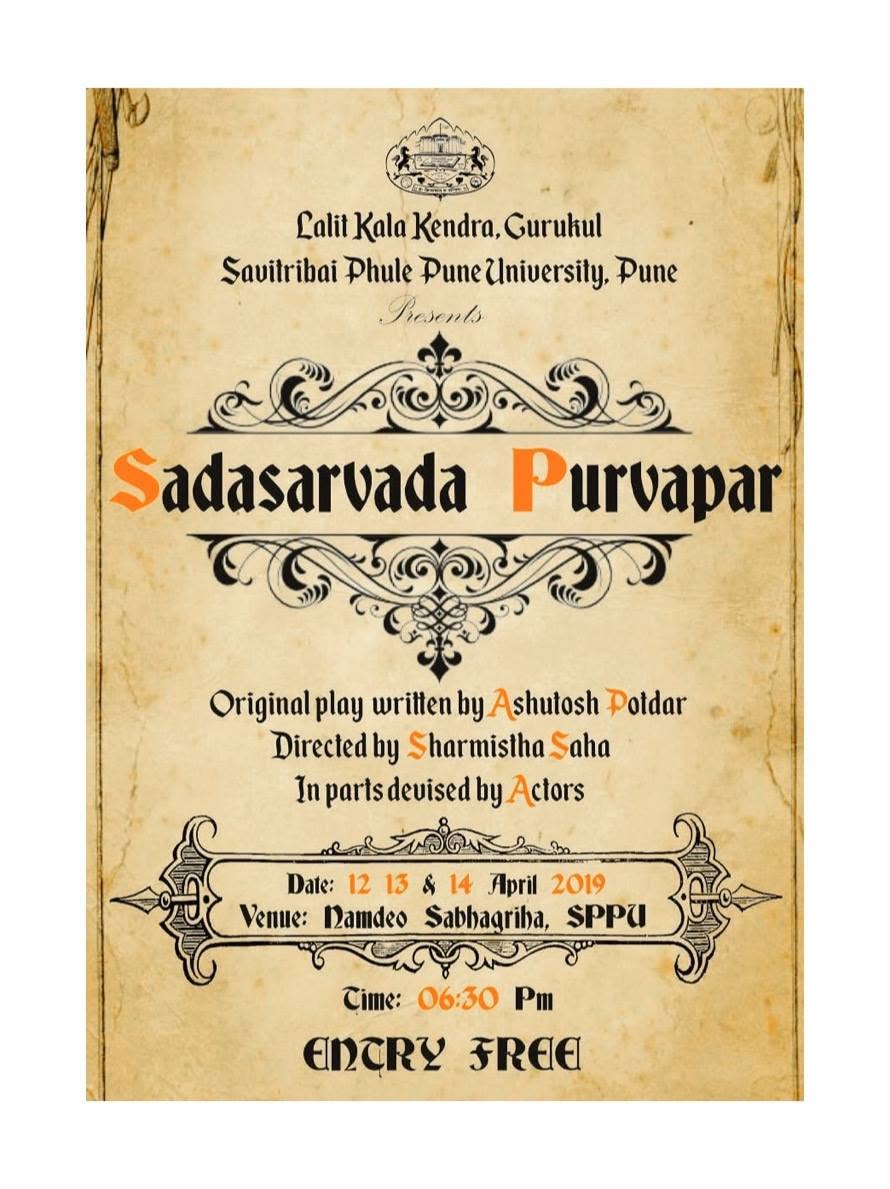
Sadasarvada poster

02
bottom of page